
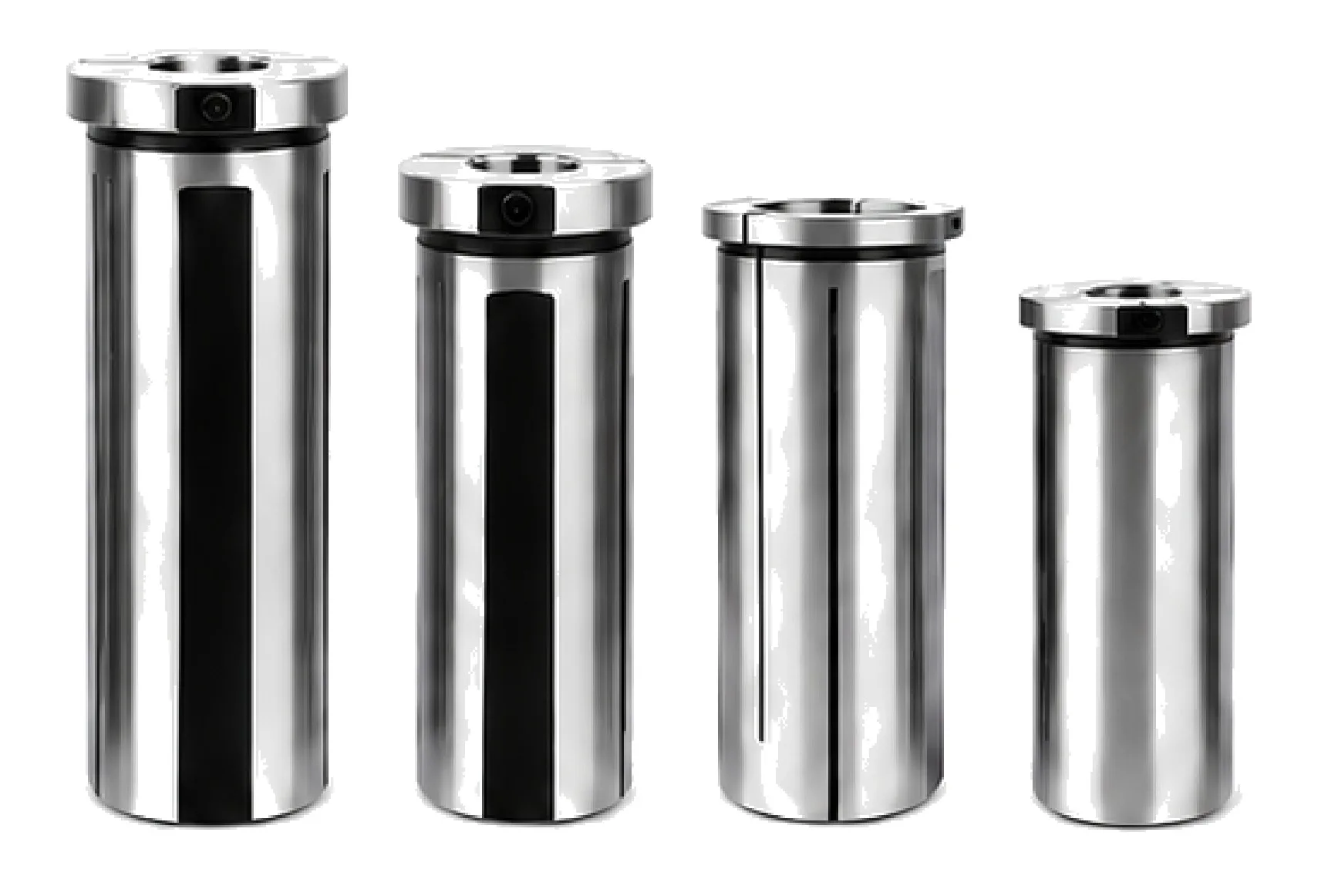
Precision clamping sleeve for boring bars & round shank tools. Stable clamping · fast tool change · accurate centring.
The AEF Boring Bar Spring Collet is a precision split sleeve developed for CNC lathes, internal turning and round shank tool clamping. Instead of pressing a set screw directly against the shank, AEF uses a slotted spring collet body: as it is tightened the sleeve contracts elastically and wraps around the shank, so clamping force is distributed evenly around the circumference and the bar is located more repeatably.
In long-overhang internal turning, with anti-vibration bars, or wherever centre height and rigidity matter, the way the bar is held between holder and turret has a direct effect on vibration, surface finish and insert life. General practice in internal turning points the same way: a cylindrical boring bar is best held in a sleeve that surrounds the shank, and for long overhangs a clamping length of roughly 4 × bar diameter is a widely used working reference.
Why AEF — 360° wrap-around clamping
A conventional reduction sleeve usually holds the bar with one or more set screws pushing from the side. That concentrates load on a small area, which becomes more critical as overhang and cutting forces increase.
The AEF slotted spring collet deforms elastically instead, wrapping the shank and spreading pressure around the full outside diameter. The design aims to:
- increase the clamping rigidity of the bar
- reduce localised single-point pressure on the shank
- improve positional consistency when the bar is re-installed
- shorten tool change and re-setting time
- reduce the effect of machining vibration on insert life and surface finish
- suit long-overhang and anti-vibration boring bars
For a cylindrical boring bar, a holder that fully surrounds the shank generally gives better stability than one relying on screws alone, because the load is carried by contact area rather than by a few small contact points.
Automatic centring
As the AEF collet is tightened it contracts towards its own centre, so a round shank tool settles naturally on the sleeve axis. Compared with a single set screw pushing from one side, this reduces the offset caused by one-sided force — useful wherever tools are changed often, or where a consistent cutting-edge centre height is required.
Centre height matters a great deal in internal turning. An off-centre cutting edge can cause unstable dimensions, abnormal insert wear, higher cutting forces, more vibration and poorer chip breaking. Anything that makes the bar sit on the same axis every time it is installed therefore shortens set-up and keeps results consistent between tool changes.
Designed for anti-vibration boring bars
A damped bar already contains a precise vibration-absorbing structure, but even with an internal damping system the overall effect can be reduced if the clamping at the holder end is not rigid enough.
At 6×D, 8×D, 10×D and beyond, the contact area, clamping length, concentricity and clamping rigidity between bar and holder all become more important. For long-overhang internal turning the working reference is correct installation, sufficient clamping contact, and a clamping length of about 4 × bar diameter.
Worked example. For a Ø25 mm anti-vibration boring bar the recommended effective clamping length is 25 × 4 = 100 mm or more. A longer engagement increases the effective contact area between bar and sleeve and raises the rigidity of the whole tool system.
Why direct screw clamping is not recommended for damped bars
An anti-vibration boring bar is not a solid steel bar. It usually contains a damper mass, elastic elements or another vibration-absorbing structure inside, so the clamping method should avoid putting unnecessary concentrated stress on the shank.
Compared with a set screw pressing directly on the side of the bar, a split sleeve or wrap-around collet increases the contact area between bar and holder. As a general principle in turning tool installation, a holder that fully surrounds the bar is the better option; V-type seats and cylindrical holders clamped directly by screws give less contact area and concentrate the load.
For high-ratio damped bars, AEF therefore works as a precision adapting and clamping element between the turret holder and the bar. The permitted clamping method for any particular anti-vibration bar should always follow that bar manufacturer’s own installation specification.
Material and manufacturing
| Material | 40CrMo alloy steel |
| Hardness | HRC 50 ±2 |
| Finish | Precision ground bore and outside diameter |
40CrMo alloy steel
AEF is made from 40CrMo alloy steel. Compared with plain low-carbon steel, 40CrMo offers good strength, toughness and response to heat treatment, which suits precision components that repeatedly take clamping load and machining vibration. Hardening and tempering raise surface hardness, wear resistance, fatigue strength, mechanical strength and toughness.
Precision ground bore and outside diameter
Both the bore and the outside diameter are precision machined and ground. The outside diameter mates with the turret holder or tool block; the bore contacts the tool shank directly. The quality of both surfaces therefore affects concentricity, clamping contact area, the centre position of the bar and repeatability after a tool change. A smooth ground surface also reduces uneven contact caused by local high spots, so clamping force is distributed more evenly.
Double locking design
The top of the AEF sleeve uses a double locking arrangement so the collet keeps a stable clamping state once tightened, reducing the risk of loosening from machining vibration, repeated cutting loads and long running hours. Combined with the slotted spring body it allows fast tool loading, reliable clamping and easy removal.
One sleeve, many applications
Although AEF is primarily a boring bar spring collet, it can be considered for any matching cylindrical shank, subject to the actual machining conditions.
| Application | Tool |
|---|---|
| Internal turning | Boring bars |
| Anti-vibration tooling | Damped boring bars |
| Drilling | U-drills |
| Drilling | Indexable drills |
| Reaming | Reamer shanks |
| Extension | Extension bars |
| Drilling | Straight shank drills |
| General | Other round shank tools |
One standard holder can cover several shank diameters simply by changing the AEF bore size, which reduces the number of holder types and the stock you need to carry.
Available sizes
| ΦD — collet O.D. | Φd — tool shank diameter | L — overall length |
|---|---|---|
| 25 mm | 6 / 8 / 10 / 12 / 14 / 16 / 18 / 20 mm | 75 mm |
| 32 mm | 6 / 8 / 10 / 12 / 14 / 16 / 18 / 20 / 25 mm | 95 mm |
| 40 mm | 8 / 10 / 12 / 14 / 16 / 18 / 20 / 25 / 32 mm | 105 mm |
| 50 mm | 8 / 10 / 12 / 14 / 16 / 18 / 20 / 25 / 32 / 40 mm | 125 mm |
| 60 mm | 50 mm | 135 mm |
Ordering code
Order codes are built as AEF + outside diameter D + “D-” + bore d.
AEF32D-20 = AEF Series · Ø32 mm outside diameter · for a Ø20 mm tool shank. Sleeve length is fixed by the outside diameter series, so L is not stated in the order code.
Typical application
A CNC lathe holder with a Ø32 mm bore needs to take a Ø20 mm anti-vibration boring bar → order AEF32D-20. The Ø32 outside diameter fits the existing holder and the Ø20 bore clamps the bar, so there is no need to replace the whole holder.
Why clamping matters
In internal machining the insert is only the front end of the cutting system. Real rigidity comes from the whole chain:
Machine → Turret → Tool holder → Collet / sleeve → Boring bar → Insert
Any gap, eccentricity or insufficient clamping anywhere along that chain can become a source of vibration, and the further the bar is extended the more sensitive the system becomes. Steel, carbide and damped bars each allow a different overhang ratio, but in long-overhang work correct wrap-around clamping and sufficient clamping length remain the basis of a stable set-up.
AEF is therefore not only a way to fit a small bar into a large holder. Its real job is a stable connection between tool holder and boring bar.
Key benefits
- High clamping rigidity — wrap-around clamping increases contact area with the shank.
- Automatic centring — elastic contraction helps a round shank hold its centre position.
- Fast tool change — no repeated single-point screw adjustment when swapping tools.
- 40CrMo alloy steel — high-strength material for heavy-load machine tool clamping.
- HRC 50 ±2 — heat treated for wear resistance and long-term stability.
- Precision ground — ground bore and O.D. for a better fit to both holder and bar.
- Wide application range — boring bars, U-drills, reamers, extension bars and other round shank tools.
- Ideal for damped boring bars — where high clamping rigidity and long overhang are required.
FAQ
How is AEF different from an ordinary boring bar sleeve?
An ordinary reduction sleeve is mainly there to fit a smaller bar into a larger holder. Besides the size adaptation, AEF uses a slotted body that contracts elastically, so the bar gets a fuller wrap-around grip. The emphasis is on clamping rigidity and centre location, not just diameter reduction.
Can I use it with an ordinary steel boring bar?
Yes. As well as damped bars, any suitable cylindrical shank works as long as the D / d sizes match and the machining conditions allow.
Can I use it with a U-drill?
Yes. AEF can be used with correctly sized straight shank U-drills, indexable drills, reamer shanks and other round shank tools.
How much clamping length does an anti-vibration bar need?
As a general rule for long-overhang boring bars, take 4 × bar diameter as the key reference. For a Ø20 mm bar that means an effective clamping length of about 80 mm.
Can I clamp a damped bar directly with a set screw?
For high-precision or anti-vibration bars, a single screw pressing on the shank is not recommended as the primary clamping method. Full wrap-around clamping normally gives better contact and stability. The actual requirement should always follow the bar manufacturer’s specification.
Download
AEF Boring Bar Spring Collet — catalogue (PDF)
Contact us for availability, pricing and lead time, or tell us your holder bore and bar shank diameter and we will confirm the right AEF size for you.