
SEMICON Taiwan 2026 runs from 2 to 4 September at the Taipei Nangang Exhibition Center, Halls 1 and 2, with the forum programme opening on 31 August. This edition carries the theme Transform Tomorrow: more than 1,300 exhibitors, 4,300 booths, participants from 65 countries and regions, an expected 100,000+ trade visitors, and over 22 professional forums.
It is not a metalworking show. But the share of machinery, equipment and tooling suppliers on the exhibitor list has been climbing for several years now, and that trend alone is worth three days of anyone’s time on the machining side.
ACCuratech Dynamics attends as a visitor, not an exhibitor. Here is how we think a machining or tooling supplier should read this show, and what we are going there to find.
1. Two different shows under one roof
The main halls speak the language of advanced process, advanced packaging, materials and metrology. That is the world of fabs and equipment majors, and wandering through it without a plan burns a day fast. For anyone on the machining side, the material that is actually relevant sits in a handful of specific zones. Spend the time there and three days is plenty; spend it elsewhere and you go home with nothing.
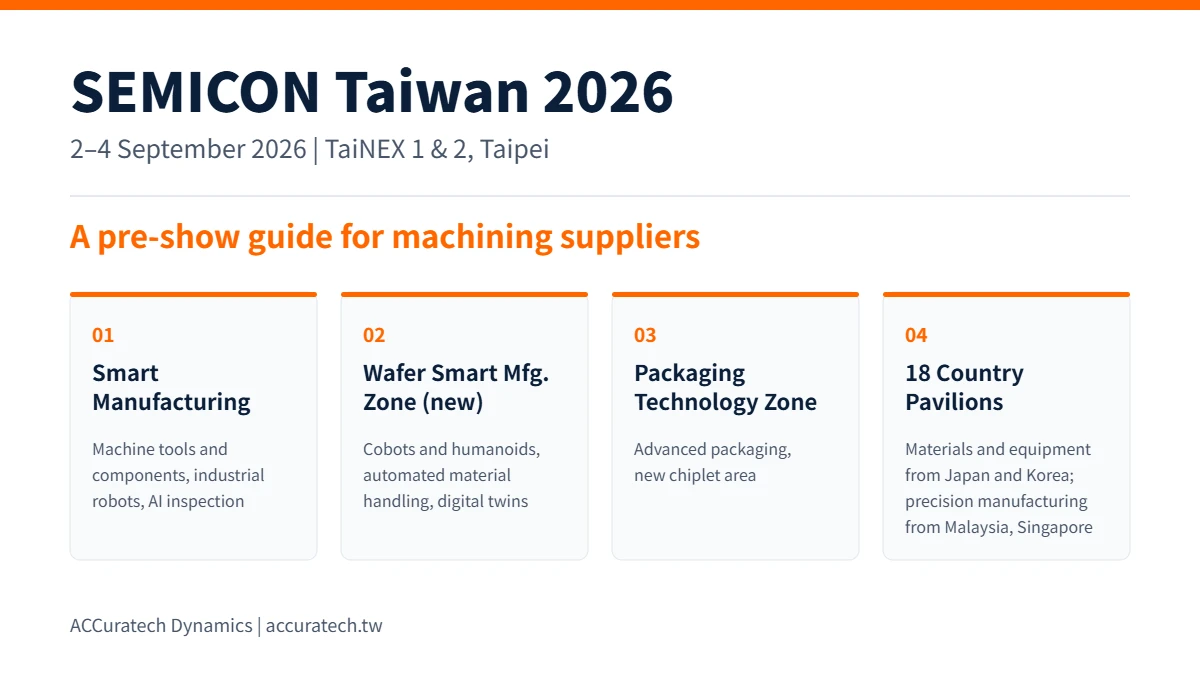
2. Four zones that matter to machining suppliers
1. Smart Manufacturing Pavilion. The closest thing to familiar ground: 47+ exhibitors across smart factories, automation systems, industrial robots, AI inspection, industrial IoT, smart logistics and AMRs, 5G applications, and machine tools and components. Yaskawa, Festo, Beckhoff, Techman Robot, Kawasaki, Advantech, Siemens and ifm all exhibit here. If you only have half a day, start here.
2. Wafer Smart Manufacturing Zone (new this year). The theme is how a fab becomes an intelligent production system: collaborative robots, humanoids, automated material handling, digital twins. What to look at here is not the robots themselves but what a fab demands of a part — cleanliness class, material restrictions, tolerance bands. Those conditions travel back up the chain to whoever machines the part.
3. Packaging Technology Zone, with a new chiplet area. Advanced packaging is the fastest-growing segment in the industry, and it keeps pushing specifications upstream: substrates, fixtures, thermal structures, test interfaces — every one of them tighter than the previous generation. If you want to know what kind of difficult part will land on your desk in two years, this is where you can see it.
4. International pavilions. Eighteen countries and regions have pavilions this year, with 220 international booths — up more than 250% from 62 in 2023. Australia leads with critical minerals and advanced materials; Korea with semiconductor equipment, materials and automation; Japan brings regional pavilions from Fukuoka, Miyagi and Ibaraki; Malaysia and Singapore focus on precision manufacturing and automation. Europe is represented by Catalonia and Italy, with the UK and Finland exhibiting for the first time. North America brings a US pavilion covering 11 states, plus Chihuahua, Mexico, in its first appearance. For a Taiwanese supplier looking for overseas customers, this may be the highest-return floor space at the show.
3. Three questions worth preparing
Everyone on a show floor claims high precision. Questions separate capability from marketing faster than business cards do.
Who defines the specification? Many parts on display were made to a customer’s drawing, which is not the same as being able to define a process. Find out where the design authority sits and you know whether you are talking to a partner or a distributor.
Is there measured data on hard-to-machine materials? Ceramics, silicon carbide, tungsten carbide, titanium — ask which material, which tool, which parameters produced the result, and whether the numbers are measured or simulated.
How is low-volume, high-mix supported? Semiconductor equipment parts share a profile: small quantities, extremely tight tolerances, compressed lead times. Ask about minimum order quantity, lead time on specials, and how rework is handled. The answers sort suppliers quickly.
4. What we are going to find: machining solutions for SiC substrates
To be specific about it: the two areas where our own work touches the semiconductor supply chain most often are micro-diameter drills and the machining demands around probe cards. Both are moving the same direction — holes getting smaller, boards getting thicker, materials getting harder. Every time the specification moves up a notch, another group of suppliers drops out of the running. That is pressure on the supply chain and opportunity for whoever can still deliver.
This trip we are primarily looking for machining solutions for silicon carbide substrates. The difficulty with SiC is not that it cannot be cut; it is that the material is hard enough to change the logic of the whole process. It is a classic hard-to-machine material, substantially harder than conventional silicon, so processing is grinding-led and typically splits into three stages: rough grinding to remove stock, fine grinding to control thickness, and dry polishing, which directly affects the finished wafer’s bending strength. The choice of wheel decides more than throughput — it decides whether the process stays stable and whether yield holds.
So the questions we will be asking are simple ones: who is actually machining SiC, with what tooling and what parameters, at what yield and what capacity, and how far Taiwan’s supply chain really reaches on this particular material.
Our take
On the face of it, a semiconductor show is not our show. But our experience over the past few years is consistent: the place where specifications are pushed to the limit first is the place where tooling requirements change first. By the time that demand shows up at a metalworking exhibition, it is usually two or three years old. Seeing it a year early buys a year of preparation.
If you are attending SEMICON Taiwan 2026, or you are looking for Taiwanese machining capacity for silicon carbide, micro-diameter drilling or probe card related work, email us at info@accuratech.tw. We are on the floor on 3 September. Bring an actual part or drawing — five minutes on a real component beats an hour of capability slides.
Show information
- Show: SEMICON Taiwan 2026
- Dates: 2–4 September 2026 (forum programme from 31 August)
- Venue: Taipei Nangang Exhibition Center, Halls 1 and 2
- Theme: Transform Tomorrow
- Website: semicontaiwan.org/en